 BMW.SG | BMW Singapore Owners Community The Ultimate BMW Community – Established Since 2001
The 2027 BMW X5 marks a fresh chapter for the brand’s bestselling SUV, and we have just sampled prototypes of the three powertrains it will launch with. The line-up pairs two 3.0-litre turbo inline-six petrol units, boosted by mild and plug-in hybrid systems in the 40 and 50e xDrive models, with a fully electric iX5 60 xDrive. This fifth-generation machine, built in South Carolina, arrives late this year carrying a longer wheelbase, sharper electronics and serious technology upgrades, yet it still aims to feel every bit an X5 behind the wheel.

Underneath sits an evolved version of BMW’s CLAR architecture, reworked to stretch the wheelbase by 2.4 inches and overall length by 2.6 inches while width and height shrink fractionally. The clever floorpan accommodates either an underfloor battery with front and rear motors or the traditional layout. Every X5 gains adaptive damping with steel or air springs, while electromechanical roll stabilisation and rear steering are optional. A neat revision separates the rear spring and damper units, freeing up volume in the air spring to lift comfort and support the heavier electric variants with ease.
On the powertrain front, the 40 xDrive musters 394bhp from its petrol engine and light hybrid motor, while the 50e xDrive blends a milder engine with a motor strong enough to run the car alone for a combined 483bhp. The headline act is the iX5 60 xDrive, drawing 245bhp at the front and 325bhp at the rear for 570bhp total. Its 141kWh pack runs at 800 volts and charges at 450kW or better, with range expected to approach 400 miles. All models adopt a strikingly modern Neue Klasse cabin with the pillar-to-pillar Panoramic iDrive display.
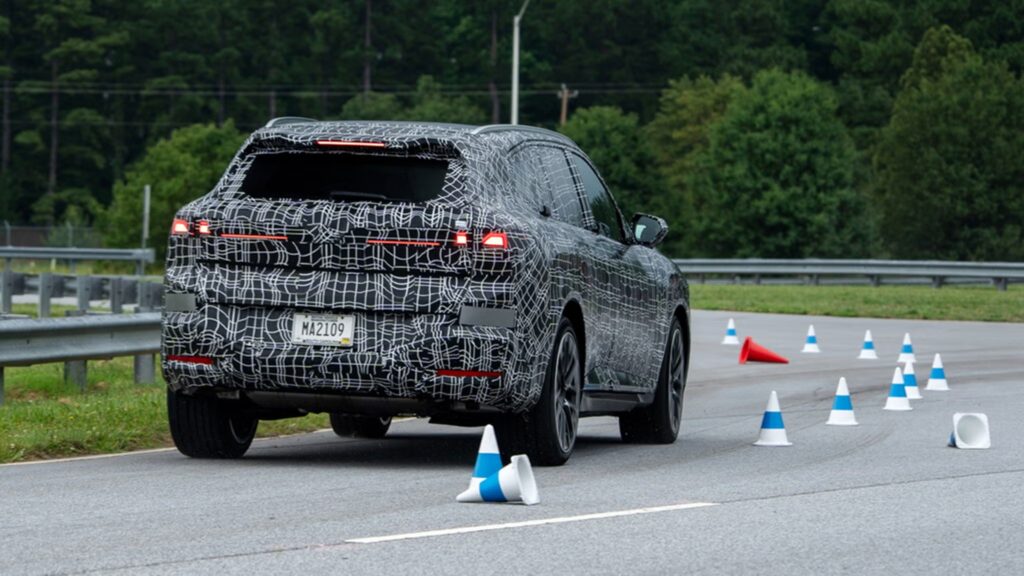
Out on the road, the trio drives more alike than their differing weights might suggest. Rear steering trims yaw, active roll stabilisation reins in body lean, and BMW’s Lateral Dynamics Management keeps everything composed, so the heavier 50e darts through corners almost as keenly as the lighter 40. The iX5 leans on its Heart of Joy computer to juggle acceleration and regenerative braking with real authority, delivering remarkably tidy transitions and the same wonderfully soft stops we admire in the iX3. Even so, the 40 feels the lightest and most nimble of the bunch.
Technology runs deep throughout the range. Drivers can tailor regenerative braking, chassis stiffness, steering feel and even sound character across Personal, Sport and Efficient modes. The collaborative driver-assist suite shines, with adaptive cruise that holds steady through tight lanes and a glance-to-confirm lane change feature. A clever parking system can memorise a route through a multi-storey, hunt for spaces and reverse in by itself at low speed. Big it may be, but this software-defined X5 still drives smaller than its dimensions imply, with the affordable 40 shaping up as an early highlight.